
Farmers trained in Vermicompost production in Shuklaphanta Municipality
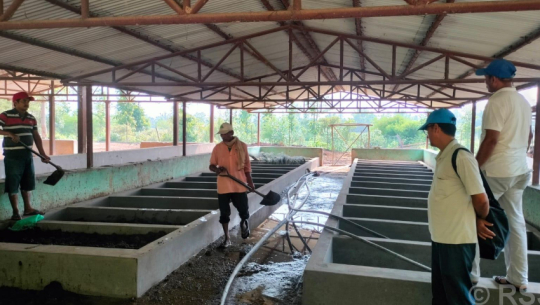
Kanchanpur: Farmers who have long relied on chemical fertilizers are increasingly turning toward vermicompost as a sustainable alternative.
Interest in vermicompost has grown among farmers due to its role in preserving soil fertility, improving product quality, and creating opportunities for additional income. To encourage this shift, Shuklaphanta Municipality has launched a campaign to equip farmers with skills related to vermicompost production.
Under the municipality’s “One Ward, One Enterprise” program, 25 farmers recently participated in a three-day theoretical and practical training conducted in collaboration with the NGO Needs Nepal. The training covered the production process, importance, commercial potential, and marketing strategies of vermicompost.
Training instructor and vermicompost producer Bir Bahadur Hamal stated that excessive use of chemical fertilizers has led to declining soil quality, making it necessary to promote organic alternatives. He emphasized that farmers are now seeking solutions as soil health deteriorates and production costs rise. According to him, vermicompost acts as a ready-made plant nutrient, showing effects within four to five days of application. It contains 13 essential nutrients, including nitrogen, phosphorus, potash, zinc, calcium, and boron, and helps improve soil structure, water retention capacity, and biological activity.
In recent times, farmers involved in vegetable, fruit, horticulture, and nursery farming have shown increasing interest in vermicompost. Hamal noted that while it was previously difficult to promote its importance, current demand has made it challenging to meet supply needs.
Hamal, who has been producing vermicompost in Nepalgunj since 2071 BS, produces 64 tons annually and supplies it to 10 districts across Lumbini, Karnali, and Sudurpaschim Provinces. He reported earning an annual income of Rs 20 to 25 lakh from the business.
He also highlighted that vermicompost production does not require large investments. Farmers can produce it using cow dung, organic waste, and worm seeds in open spaces or sheds. Vermicompost is currently sold at Rs 30 to 35 per kilogram, while worm seeds can fetch up to Rs 2,000 per kilogram. He added that farmers can generate significant income not only from fertilizer production but also from selling worm seeds, creating opportunities to combine agriculture with entrepreneurship.
Shuklaphanta Municipality has also initiated plans to expand vermicompost production commercially. According to Dhan Bahadur Chaudhary, head of the municipality’s enterprise branch, 28 pits have been constructed at a community cowshed in Shuklaphanta-9 to support production. He stated that the goal is to utilize daily cow dung for commercial vermicompost production while motivating farmers by providing both skills and necessary tools on a grant basis.
The municipality said the program aims to manage cattle dung, promote environmental sanitation, and produce organic fertilizer locally. Farmer Lalit Bahadur Saud, a participant in the training, shared that he gained practical knowledge and realized that while chemical fertilizers may increase short-term production, they weaken soil over time. He added that he now plans to produce vermicompost at home for personal use and sale.
Under the “Women Entrepreneur Empowerment Project through Sustainable Income” run by Needs Nepal, women and farmers from Shuklaphanta, Bedkot, and Krishnapur municipalities are also receiving training in vermicompost production. Project coordinator Hemanta Shahi stated that the initiative collaborates with community cow shelters to provide skill-based training and facilitate experience sharing among farmers.
He emphasized that hands-on learning is more effective than classroom instruction, which is why participants are taken to farms to observe the complete production process. According to him, the growing demand for organic products has increased the importance of vermicompost, making it not only an agricultural support activity but also a profitable enterprise that contributes to environmental protection.