
National paddy day celebrated on Asad 15 with rice planting and curd consumption
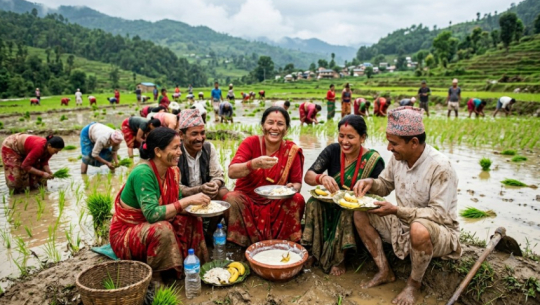
Kathmandu: Paddy Day, which is observed every year on Asad 15, is being celebrated today through rice planting activities in the fields and the traditional practice of eating curd and beaten rice. Farmers, after working in the fields, consume curd to regain strength. It is believed that curd and yogurt help cool the body during this period and restore energy.
Asad 15 is also widely recognized as a cultural festival of consuming curd and beaten rice in Nepali society. People engaged in professions and businesses outside agriculture also mark the day by eating curd and beaten rice. Curd holds an important place in Nepali culture. It is traditionally applied on the forehead as a red tika before leaving home for auspicious work or traveling abroad. Serving curd before departure is considered a sign of good omen and blessings, and it is believed to bring good fortune.
From a scientific perspective as well, curd is considered beneficial for health. It is said that Guru Gorakhnath had predicted that Prithvi Narayan Shah, the unifier of Nepal, would become powerful after being given yogurt. In Ayurveda, it is mentioned that drinking buttermilk made by churning yogurt at the end of a meal helps maintain health, expressed in the phrase “Bhojanante pibet takram vaidyasya kin prajayam.” Yogurt is also believed to aid digestion.
Eating yogurt and beaten rice during diarrhea is considered a natural remedy, which is why this tradition is deeply rooted in Nepali culture. In this way, Asad 15 has become a nationally recognized cultural festival in Nepali society.
Rice Day was officially declared following a ministerial decision on Mangsir 29, 2061 BS, and has been celebrated as National Paddy Day since Asad 15, 2062 BS. As Nepal is an agricultural country, most of its population is engaged in farming.
During this season, farmers are busy planting rice to secure food for the year. On this day, rice seedlings are planted in muddy fields accompanied by traditional folk songs in the Asare season. Songs such as ‘Chupu ra chupu hiloma padi roper chodaula, bani kulola lagi pani aere godaula’ are sung, and people enjoy working in the fields. During this mid-summer season, young men and women use tools to prepare the fields and celebrate by splashing mud and water. There is also a belief in Nepali society that one must step into muddy fields at least once during Asar.
This year, however, due to insufficient rainfall across the country by mid-Asar, the expected level of rice transplantation has not been achieved. Farmers have also reported shortages of chemical fertilizers in some areas. The Ministry of Agriculture, Forest and Environment has stated that there is sufficient stock of chemical fertilizers.

Dineshkhabar Desk