
Putting a stamp on garbage
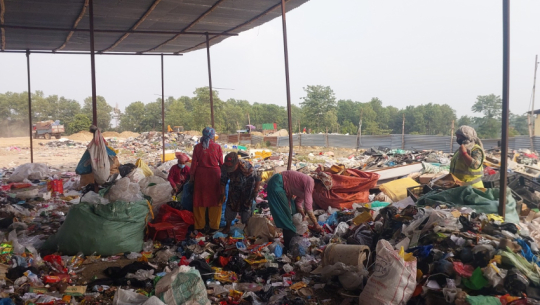
Dhangadhi: Garbage collected from the city, which was a big problem to manage in Dhangadhi until a few years ago, has now become a source of income.
Dhangadhi Sub-metropolitan City is earning an annual income of around Rs. 75 lakh from garbage. This has become a source of income after the garbage collected from the city area was classified and sold as recyclable. A garbage micro-sorting center has been established in Dhangadhi Sub-metropolitan City-2.
The center, which was put into operation about three years ago, keeps the collected garbage and classifies it into recyclable and non-recyclable and biodegradable and non-biodegradable waste. Plastic, paper, cardboard and other recyclable waste are classified and sold. This has also made it easier for the sub-metropolitan city in waste management.
The sub-metropolitan city is collecting and classifying garbage through contracts. Nandadevi Sewa Kendra has taken a contract for the collection and classification of garbage for five years. The company has been collecting waste daily from the market area and nine wards around the market out of 21 wards of Dhangadhi.
Anil Shahi, co-director of Nandadevi Sewa, informed that the classified waste is bought and taken away by traders from Biratnagar, Birgunj, Chitwan and other places. “We press reusable water bottles, cardboard, plastic films and plastic bottles of beverages in a machine to reduce their volume and put them in sacks,” he said. “Selling the waste classified in this way is also not a problem.”
After the start of waste classification, it has not only become a source of income for the sub-metropolitan city, but locals have also found employment at the classification center.
According to operator Shah, 147 people are currently working in waste collection and classification. In the past, managing waste collected from the city was a big challenge. Ashok Awasthi, head of the environment, drinking water and sanitation branch of the sub-metropolitan city, said that after the waste was classified and sold, management has become much easier. ‘There is still a problem of where to manage the waste, but we don’t have to manage all the waste like before,’ he said.
Awasthi said that an agreement was reached with Nanda Devi in Shrawan 2081 for the collection and classification of the city’s waste for an annual amount of Rs 7.1 million. According to the agreement, the company must pay the sub-metropolitan city an additional 10 percent of the increased amount every year. The agreement was made for Rs 7.1 million in the first year, but this year the amount that Nanda Devi must pay to the sub-metropolitan city has increased to Rs 8.9 million, informed the branch chief Awasthi.
According to him, 21 to 25 tons of waste has been collected from the sub-metropolitan city daily. After the classification was started, the burden of waste collection on the sub-metropolitan city has decreased.
‘There is still a problem in managing waste, including glass and some plastics,’ Awasthi said. Waste is collected daily from nine of the 21 wards of the sub-metropolitan city, while waste is collected weekly in some of the remaining wards and during local level sanitation programs in some rural areas. The company stated that biodegradable waste from kitchens and non-biodegradable waste from plastic are brought separately from house to house.
In addition, the sub-metropolitan city has also been conducting cleanliness campaigns in the neighborhoods through local neighborhood development committees, women's groups, schools, and social organizations. The sub-metropolitan city has also banned the use of polythene in Dhangadhi. Similarly, fines are being imposed if garbage is found in the market area.
Sub-metropolitan City Mayor Gopal Hamal informed that work is being done in partnership with the Asian Development Bank and the sub-metropolitan city to melt and shred some of the plastics that cannot be reused. Preparations are underway to build a structure along with the classification center and install plastic melting and shredding machines to put them into use. Mayor Hamal said that there is still a problem in waste management of multilayer plastic noodle, biscuit, etc. shells.
The sub-metropolitan city has stated that waste management will be facilitated if the integrated waste management center built in Dhangadhi-7, Patela is operational. The waste management center was built at a cost of Rs 960 million excluding VAT with the assistance of the Asian Development Bank under the federal government's Regional Urban Development Project. The sub-metropolitan city has stated that discussions are currently underway on the modalities of operating the center.

Dineshkhabar Desk