
Far west holds high hydropower potential, but infrastructure and policy barriers persist: IPPAN Chair Karki
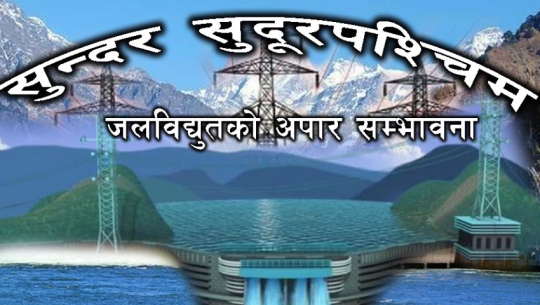
Kathmandu: Ganesh Karki, Chairman of the Independent Power Producers Association of Nepal (IPPAN), has said that although Sudurpaschim Province has high potential for hydropower production, project implementation is being hindered by lack of infrastructure, policy complexity, and legal obstacles related to forests.
Speaking at an interaction program on the possibilities and challenges of hydropower development in the Far West Province, Chairman Karki highlighted the region’s strong potential for electricity production. Describing the energy sector as the foundation of national prosperity, he emphasized the need to prioritize energy development over other sectors. He also noted that although hydropower is a government policy priority, its effective implementation remains challenging.
According to Karki, around 85 percent of Nepal’s electricity production comes from the private sector. He informed that approximately 12,500 MW of hydropower projects are currently in operation, while about 3,000 MW of projects have already secured Power Purchase Agreements (PPA). Additionally, projects with a combined capacity of around 21,000 MW are in various stages of licensing, study, and construction.
He stated that more than 20 percent of Nepal’s hydropower potential lies in the Far West Province alone, adding that electricity generated in the region could be conveniently exported to India. “There is significant potential to expand energy trade with neighboring countries,” he said.
However, Karki pointed out that inadequate basic infrastructure, particularly roads, is delaying project construction. “The road network in the Far West is still insufficient, which has increased both project costs and timelines,” he said.
He also identified legal provisions related to forests and national parks as major obstacles in hydropower development, noting that restrictions on construction within protected areas have stalled several potential projects.
Karki stressed the need for swift implementation of the government’s energy policies and manifesto commitments, while also calling for an investment-friendly environment for the private sector. “If the government facilitates, the private sector is ready to invest more,” he said.
He further emphasized the need to expand the domestic electricity market and ensure timely construction of transmission lines for electricity export. “Inability to transmit generated electricity creates problems in sales,” he said.
Highlighting hydropower as a long-term solution to the energy crisis and dependence on petroleum products and gas, Karki said that increasing both production and consumption of electricity is essential for sustainable energy development.