
Forest management disputes escalate in Far-west as consumer groups launch protest
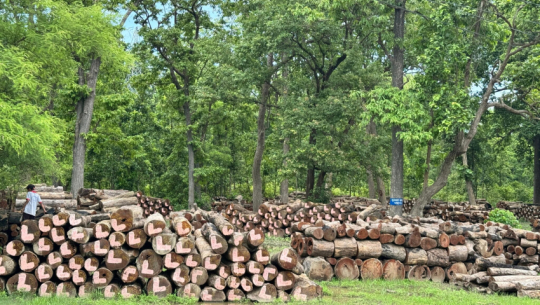
Kanchanpur: Community and partnership forest consumer groups in Sudurpaschim Province have begun a sit-in protest from today, demanding assurance of their rights and the implementation of sustainable forest management.
A provincial-level movement mobilization committee, formed with the participation of organizations including the Community Forest Consumer Federation Nepal, has started a week-long sit-in in front of the Ministry of Industry, Tourism, Forest and Environment of Sudurpaschim Province.
Forest consumer groups stated that they were compelled to launch a phased आंदोलन after their long-standing demands remained unaddressed. According to officials, community forest management has been adversely affected by policy ambiguity and practical challenges related to forest management, taxation, timber collection, and distribution.
Pushkal Bahadur Bam, Chairman of the Scientific Forest Management Committee, Sudurpaschim Province, said the existing multi-tier tax system has weakened forest consumer groups financially. He noted that timber collected from forests is taxed under multiple headings by federal, provincial, local governments and the Internal Revenue Office, resulting in double and triple taxation. He said this has reduced their ability to invest in forest management and stressed the need for a single-door tax system.
Mahesh Dutt Joshi, Chairman of the Community Forest Coordination Committee, Kanchanpur, expressed concern that necessary regulations have not been fully implemented even three years after the Forest Act came into force. He said the lack of implementation of the sustainable forest management (silviculture system) procedure has hindered timber collection from community forests, leading to timber rotting inside forests.
“Timber is rotting inside the forest, but consumers are forced to purchase expensive timber from external markets,” he said. “Foreign timber, including from Malaysia, is being imported at high prices, while timber from our own forests remains unused.”
Bir Bahadur Rajbanshi, Secretary of the Community Forest Facilitation Committee, said the ban on timber collection has also negatively affected forest conservation. He said it has become difficult to generate necessary resources for forest management and maintain forest vigilance.
The agitating groups have put forward a 24-point demand, including immediate implementation of sustainable forest management procedures, provision of revolving funds and concessional loans, and amendment of conflicting provisions between federal and provincial forest regulations.
They have also demanded autonomy for forest user groups in determining the pricing and sale of timber and firewood, arrangements for internal consumption of wood, and provisions for collecting additional timber as required.
Other demands include controlling forest encroachment, stricter restrictions on extraction of stone, gravel, and sand in river and Chure areas, concessional loans and grants for timber and non-timber industries, and facilitation of exports after processing.
According to Punaram Chaudhary, General Secretary of the Scientific Forest Management Committee of Sudurpaschim Province, additional demands include mandatory use of indigenous timber in construction of government and non-government structures, capacity development programs for forest user groups, use of digital technology in record-keeping and accounting systems, and recognition of the forest sector’s contribution to national income.
He also called for ending syndicates in timber auctions, implementing a transparent e-tender system, simplifying forest product management, and ensuring the rights of local communities. He noted that although community forestry has been recognized as a successful conservation model in Nepal, its effectiveness has recently been questioned due to policy ambiguity, taxation issues, and management challenges, highlighting the need for long-term solutions through dialogue and coordination among stakeholders.
The protesting forest user groups have warned of stronger agitation if their demands are not addressed and have urged the government to take immediate and concrete steps, emphasizing that sustainable forest management and protection of local community rights should be a state priority.

Dineshkhabar Desk