
Kailali municipalities urge farmers not to burn wheat stubble, warn of environmental and safety risks
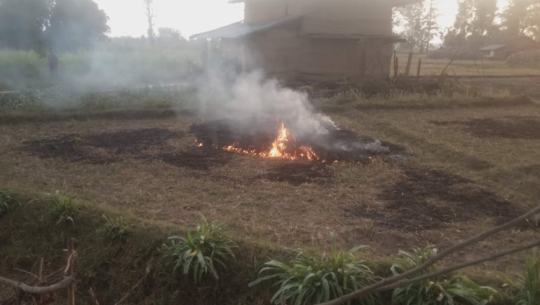
Kailali: Local municipalities in Kailali have urged citizens not to set fire to fields while cleaning wheat stubble.
Municipal authorities have requested farmers to avoid burning fields after harvesting wheat, stating that such practices harm soil safety, pollute the environment, and increase the risk of fires spreading to nearby settlements.
Farmers in Kailali and Kanchanpur districts of the Far West have already completed wheat harvesting. Janaki Rural Municipality in Kailali has called for public awareness, warning that burning fields to clear wheat residue could lead to loss of property and lives.
Disaster Contact Person Netra Prasad Jaisi informed that the rural municipality has encouraged farmers to provide wheat stubble and chaff free of cost to cattle in cowsheds. The cowshed in Tikapur Municipality-2 shelters stray cattle from both Janaki Rural Municipality and Tikapur Municipality. Ratan Dhami of Janaki-4 said that when cattle face food shortages, it would be more beneficial for farmers to provide feed rather than burning the fields.
Joshipur Rural Municipality has also appealed to residents to avoid setting fires, noting a rise in such incidents. Agriculture officer Sanjay Chaudhary said that burning fields destroys microorganisms, reduces soil fertility, and degrades its physical, biological, and chemical properties. He added that the municipality has requested farmers to collect and sell chaff to the Gaushala run by the municipality, as burning reduces animal feed and contributes to environmental pollution.
The municipality has notified farmers willing to sell wheat chaff at a fixed price to apply. It will purchase the chaff for animal feed at rates of Rs 3,700 per trolley and Rs 2,500 per dulum, with delivery to the Kanji House in Joshipur-3, Banjariya.
Similarly, Tikapur Municipality has also urged residents not to burn their fields. Previous incidents of fire have led to increased awareness efforts in recent years. Nirmala Chaudhary, head of the disaster management branch, said that fires set to clear fields sometimes spread to homes and settlements. She noted that limited resources, including only one fire engine and insufficient manpower, often force authorities to respond to field fires.
The Ministry of Land Management, Agriculture and Cooperatives of the Far West has also advised against burning fields, citing soil protection concerns. Crop Development Officer Girish Raj Joshi said that burning increases pollution and kills beneficial insects in the soil. He suggested that instead of burning, farmers should plow and turn the residue into manure, and also consider cultivating dung as green manure on currently barren land.
Due to increased awareness since last year, only three fire incidents have been reported in Tikapur so far this year, compared to 12 during the same season last year. The Tikapur fire brigade provides services to Janaki Municipality, Joshipur Rural Municipality, Bhajani Municipality, and Rajapur Municipality of Bardiya. This year, some relief has been observed after a fire brigade was established in Bhajani. During the summer season, fires often occur due to minor negligence.

Dineshkhabar Desk