
House of Kailali-2 MP KP Khanal found without legal documents or map approval
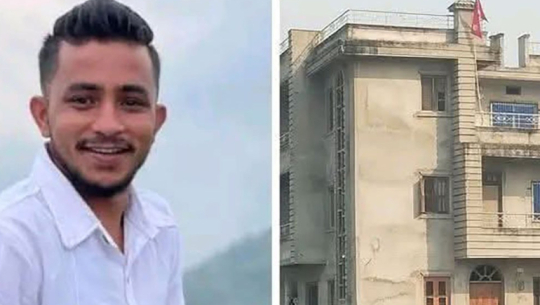
Dhangadhi: Amid strict action by Prime Minister Balendra Shah against structures built on public and encroached land, it has come to light that the house of his own party MP KP Khanal was also constructed on public land without legal documents or map approval.
The house under construction near the bus park in Lamki Chuha Municipality-1, Kailali, has been found to be located on public land. While the government has been using bulldozers against structures lacking legal documents and map approval, the case of MP Khanal—considered close to the Prime Minister—has drawn attention in political circles.
MP Khanal’s parents have been working as laborers in India for a long time and are still there. His personal secretary Hark Pun stated that the house in Lamki was built using money earned in India. However, he acknowledged that the house does not have legal documentation. According to him, although the house is on public land, it was not built through encroachment but with the family’s own investment.
Khanal, elected from Kailali Constituency No. 2, had presented himself during the election as a squatter and a candidate living on public land. He had sought voter support by highlighting his background as the son of landless parents.
Now, the revelation that he constructed a house on public land without obtaining land ownership documents has led to criticism.
Lamki Chuha Municipality Mayor Sushila Shahi said that the house lies within an unorganized settlement area where land titles have not yet been distributed. She noted that although processes such as name registration have been completed by the Land Commission, land ownership certificates have not yet been issued, and it is not possible to obtain a land title for a house built on public land.
The issue extends beyond MP Khanal, as thousands of families are living in unorganized settlements in the Lamki area. According to the Land Problem Resolution Commission, Lamkichuha has 16,500 unorganized households, 1,226 landless Dalits, and 1,918 landless squatters. Across the district, more than 140,000 families have applied for land.
The situation has sparked debate over the government’s use of bulldozers in public and encroached areas without resolving landlessness, and whether structures belonging to ruling party members will face similar action.

Dineshkhabar Desk