
Who will understand the pain of farmers?
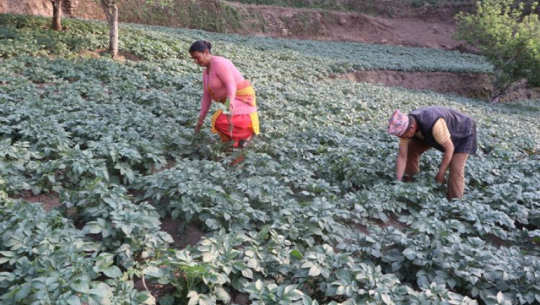
Darchula: As the morning sun begins to shine on the hills of Dallekh in Naugad Rural Municipality-2, the polyhouses built on the banks of the Khar settlement below appear white. Somewhere tomatoes are blooming, somewhere the greenery of potatoes is spreading. Farmers have been busy watering, arranging polyhouses and tending to their crops since morning, but countless pains of farmers are hidden within this greenery. Production has increased, hard work has increased, but the market is still uncertain. The road is not reliable. Prices are limited to the control of traders.
Saraswati Dobal Manyal of Naugad Rural Municipality-2 earned Rs 700,000 by selling tomatoes and potatoes during this season last year. She reached the district headquarters, Khalanga, from Dallekh to sell the vegetables grown in her own field. But she said that along with income, struggle has also increased. “Eight to ten crates of tomatoes ripen at a time,” she said, “but once they are taken to the market, they are not sold in one place. You have to go around looking for traders. Sometimes you have to go door to door to sell them.” She said that spending the whole day selling tomatoes makes it difficult to maintain the polyhouse at home, and she faces problems from production to security and searching for markets alone.
The Khar-Khalanga road is often blocked during the rainy season. Since the road is not blacktopped, landslides occur as soon as it rains, and due to lack of drainage, floods wash away the road and potholes increase. This road section, which falls under Mahakali Municipality-2 and 3, has deteriorated in places. No walls have been built at the landslide sites yet. In areas such as Dunguri, vehicles are still forced to drive in the river.
When the road is blocked, farmers have to walk for three to four hours carrying vegetables on their backs to reach Khalanga. “The road closes as soon as it rains,” Saraswati said. “Ripe tomatoes rot in the field. Investments are lost.” Vegetable farming has become her family’s main source of income. This farming has borne the education expenses of her son Milan Manyal and daughter Sonia Manyal. “I dream of giving my children a good education,” she said emotionally, “but sometimes I get very frustrated when I don’t get a market and a price.” Her husband Madhav Manyal has gone to Kathmandu in search of employment, and the family’s financial responsibility now lies with farming.
Saraswati became even more emotional when recalling the huge damage caused by the hailstorm that hit the polyhouse this year. She said she cried in the field when the plants she had grown with hard work were destroyed in a few minutes. Nara Manyal, another farmer from Khar, is also in a similar situation. Sometimes, the organic tomatoes she produces with hard work are not sold even for Rs 50 per kilo. “Last year, we sold for Rs 50 to Rs 80,” he said, “but we don’t get regular markets. When tomatoes ripen all over the village at once, traders reduce the price.”
Although Khalanga is the main market in the district, traders do not buy farmers’ produce in bulk. Farmers are forced to go around looking for traders themselves. Farmers say that with the decrease in the arrival of Indian vegetables, traders have started calling them. They do not even come to weigh vegetables properly. Since women go to the market more often, they also face the problem of being cheated. “We were cheated many times just by weighing the kg,” said farmer Saraswati Manyal, “We had to ask the administration for help once.” According to her, if farmers had a system to sell from a single center, market management would be easier.
According to Dandabag Agricultural Group President Dhansingh Sitoli, the group alone produces more than 50 to 60 quintals of tomatoes every year. Potato production is also significant. “Our main problem is the market and the road,” he said, “Production is happening, but farmers are not getting a fair price.”
He said climate change has created problems for vegetable farming. Due to hail, heavy rain, windstorms and new diseases, vegetable production has been declining. “This year, the problem was seen right from the time of sowing,” he said, “The disease has also occurred during ripening. We have changed the seeds many times, but there has been no significant improvement.” Preventive medicines have been administered and sowing has been changed from time to time, but problems continue.
Farmers in the Khar region cannot preserve their produce for a long time due to lack of cold storage. When all farmers bring vegetables to the market at the same time, prices decrease further. The vegetables produced here are completely organic and pesticide-free, farmers say. Five to 10 kg of tomatoes grow on one plant. Ordinary farmers are earning between five and seven lakh rupees in a season. More than 25 families are affiliated with the Dandabagh Agricultural Group.
Naugad Rural Municipality has declared the Khar region a vegetable pocket area. Most houses here have five to seven polyhouses. Farmers have abandoned traditional farming and started growing vegetables only. According to Prakash Singh Dhami, head of the agriculture branch of Naugad Rural Municipality, more than 150 polyhouses are currently in commercial production in ward number 2 alone. “There is a plan to expand the number of polyhouses to 10 per farmer in the coming fiscal year,” he said.
The rural municipality has stated that irrigation, seeds, medicines and compensation programs will be introduced through the upcoming budget. Agricultural technicians have been mobilized for disease management. This time, a few farmers have seen problems with their vegetables. Dhami said integrated pest management has been implemented to prevent disease. The entire ward is a vegetable pocket area. 25 to 30 families are grouped and training is being provided through farmer schools, from planting vegetables to seed and marketing. Some wards have been declared potato pocket areas. With the road network connecting the rural municipality, farmers are being provided with management.