
Dasharath Chand Health Science University says it is fully prepared to launch academic programs
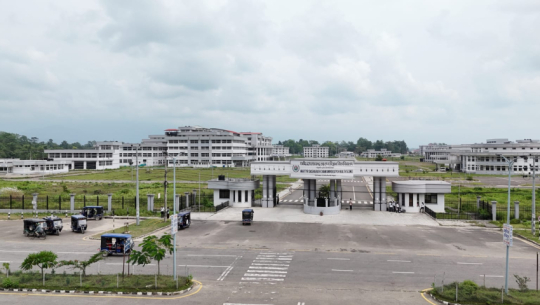
Sudurpaschim: Shaheed Dasharath Chand Health Science University has stated that there are no obstacles to launching the academic programs approved by the Medical Education Commission.
The university has urged all stakeholders not to have doubts about its readiness, saying it has established the necessary infrastructure, arranged human resources, and completed institutional preparations in accordance with established standards to conduct the approved programs.
Vice-Chancellor Prof. Dr. Sunil Kumar Joshi said there were no obstacles to commencing classes for the four academic programs, for which a total of 90 seats have been approved. He explained that the Medical Education Commission determined the seat allocation through established legal and institutional procedures, taking into account the university’s existing infrastructure, human resources, and arrangements for practical training.
“The Commission determined the seat allocation based on precedents, institutional practices and standards, the university's existing infrastructure capacity, human resource management, and the assurance of practical training. We are proceeding with all our tasks based on this foundation,” Vice-Chancellor Joshi said.
According to him, curriculum development, recruitment of skilled human resources, establishment of laboratories equipped with necessary instruments, and enhancement of institutional capacity for practical training are being carried out in accordance with regulations. The university also said it had secured the necessary resources for hospital bed capacity, scholarships, and student management.
The university stated that, under the regulations of the Ministry of Health and Food Security, its teaching hospital has an operational capacity of 325 beds, with 622 beds currently under management. It has also secured Rs 73.939 million (Rs 7 crore 39 lakh 39 thousand) for scholarships.
University Registrar Dr. Bhim Bahadur Chand said the necessary foundation had been established for the 90 approved student seats: 50 in MBBS, 20 in BSc Nursing, 10 in Medical Laboratory Technology, and 10 in Optometry.
He claimed that the university's level of preparedness was significantly more advanced than that of five other health science academies established across the country over the past five years during their initial stages.
“We have infrastructure with a capacity of 920 beds. We possess the facilities to accommodate and educate over 2,000 students simultaneously. Our teaching hospital is already receiving an average of 400 to 500 patients daily,” Registrar Chand said. “We have ensured that all remaining tasks—both for the academic program and the teaching hospital—will be completed by the time the selected students arrive.”
Registrar Chand said the university had also established partnerships with Seti, Mahakali, and Lamkichuha hospitals to support its academic programs. According to him, these collaborations will expand practical learning opportunities for students while also helping strengthen the service capacity of the respective hospitals.
“When other academies in the country began their teaching operations, some did not even have a hospital with a single bed; they had to rely on collaborations with other institutions to provide services,” Chand said. “In contrast, we have our own hospital, with a capacity of over 300 beds, ready for operation. We face no issues regarding infrastructure or other resources, all of which meet the required standards.”
The university stated that its teaching hospital currently has an operational capacity of 325 beds and provides services in accordance with the regulations of the Ministry of Health and Food Security.
The hospital offers more than three dozen services, including General Medicine, General Surgery, Orthopedics, Obstetrics and Gynecology, Pediatrics, Psychiatry, Dermatology, ENT (Ear, Nose, and Throat), Neurology, and Dentistry.
It also provides emergency care, Intensive Care Unit (ICU), Neonatal Intensive Care Unit (NICU), Pediatric Intensive Care Unit (PICU), High Dependency Unit (HDU), surgical services, and post-operative care.
Other operational services include Pathology, Biochemistry, Microbiology, X-ray, Ultrasound, ECG, Echocardiography, Endoscopy, Colonoscopy, Physiotherapy, and a pharmacy.
To further expand the teaching hospital's services, the university has proposed establishing a Cath Lab for specialized cardiac care, as well as a Burn Unit and a Trauma Center. Preparations are underway to ensure the hospital operates at full capacity by arranging the necessary human resources and equipment.
The university administration said the spread of misinformation about the implementation of academic programs had created difficulties despite the completion of necessary preparations.
Vice-Chancellor Joshi noted that some candidates selected in the past had not joined the university due to confusion surrounding the recruitment process. He said similar unnecessary confusion was now being created during preparations for student admissions.
“Spreading such misinformation serves no one’s interests. Those who genuinely wish for the success of this university—a project of national pride set to begin operations after a three-decade-long wait—would not engage in such behavior. We welcome constructive oversight, but we will not be swayed by a tendency to oppose for the sake of opposition,” he said.
Prof. Dr. Joshi added that, with the support of Prime Minister and Chancellor Balendra Shah, the federal, provincial, and local governments, and the general public, the university was capable of overcoming any obstacles and moving ahead with its operations.