UN-Habitat’s field consultation on citywide inclusive sanitation system in godawari
Dhangadhi: UN-Habitat has conducted a field consultation and interaction in Godawari Municipality of Kailali regarding the expansion of a citywide inclusive sanitation service system.
On Tuesday, representatives of UN-Habitat visited the municipality and held meetings with elected representatives and municipal staff, gathering information on the existing sanitation situation, challenges, and opportunities in the municipality. During the interaction, they shared information and exchanged experiences on possible approaches, resources, and policy aspects to ensure citywide inclusive and safe sanitation services.
UN-Habitat has been promoting the Citywide Inclusive Sanitation (CWIS) approach in four countries. This approach emphasizes policy development, monitoring, and capacity building to ensure universal access to safe and inclusive sanitation services.
The Citywide Inclusive Sanitation Alliance Nepal (CWISAN), established in December 2021, has its secretariat at the UN-Habitat Nepal office. CWISAN is a collaborative platform of 22 member organizations, including academic institutions, civil society organizations, bilateral and multilateral agencies, national and international non-governmental organizations, media, the private sector, and United Nations agencies.
UN-Habitat has been playing a coordinating role between the Government of Nepal and various partner organizations, advocating for inclusive and safe sanitation services at all levels of government through the citywide inclusive sanitation approach. In Nepal, the program is being implemented in partnership with five key organizations and CWISAN.
According to Godawari Municipality staff member Keshav Raj Pant, the municipality’s wastewater treatment plant has a capacity of only 12 cubic feet, which is insufficient to meet current needs. As a result, tankers carrying fecal sludge are required to wait for long periods, creating problems in sanitation operations and leading to unmanaged waste management.
He stated, “Along with the lack of infrastructure and budget, low public awareness is also a major challenge. Although there are legal provisions against irregular waste management, fines and enforcement actions have not been effectively implemented.”
Pant further noted that compared to Godawari Municipality, Dhangadhi Sub-Metropolitan City has allocated a larger budget and more financial resources for fecal sludge and waste management. In addition, Dhangadhi has a higher number of both paid and unpaid volunteers working to raise public awareness on safe sanitation.
Govinda Shrestha, Senior Water, Sanitation, and Hygiene (WASH) Policy Advisor at WaterAid Nepal, emphasized that clear policies, adequate infrastructure, and evidence-based planning are essential to ensure inclusive and safe sanitation. According to him, limited treatment capacity, technical problems, and low public awareness are common challenges faced by many cities in Nepal.
According to Rajesh Manandhar, Citywide Inclusive Sanitation Technical Officer at UN-Habitat, they are also working on Water and Sanitation (WASH) plans, where 90 percent of the work focuses on drinking water and 10 percent on sanitation. He also suggested that Godawari Municipality focus more on fecal sludge management compared to other types of waste management and develop itself as a model municipality.
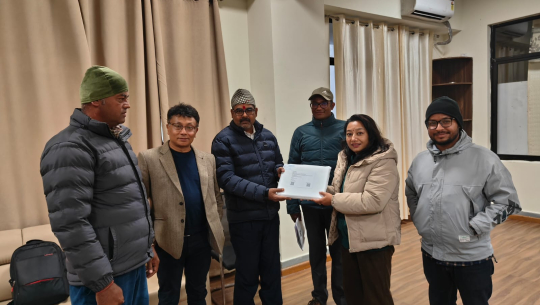
Meanwhile, UN-Habitat officer Bhintuna Shrestha handed over two new CWISAN publications, along with some earlier study and project documents, to Godawari Municipality. The new documents include Nepal’s Sanitation Journey, which analyzes key milestones in the country’s sanitation sector, and another case study document titled Compendium of Good Practices, which highlights nine major best practices from nine different CWISAN member organizations. These materials are expected to support the municipality in research, policy formulation, and the promotion of inclusive and safe sanitation services.
Municipal officials have welcomed UN-Habitat’s initiative positively and expressed their commitment to developing strategies and plans in the coming days to ensure the sustainability of inclusive sanitation services in the municipality.

अनुभव भट्ट, दिनेश खबरका संवाददाता हुन्। उनले समसामयिक विषयमा कलम चलाउछन्।